


Walk onto any factory floor and look at a robotic cell down for maintenance. Nine times out of ten, the problem isn’t a blown servo motor or a massive software glitch. The machine stopped because a twenty dollar cable failed after a million cycles of continuous twisting.
Cables in robotics take an unbelievable amount of abuse. We often treat them like static infrastructure when we really need to treat them as dynamic mechanical components. Designing cables for robotic systems is a completely different discipline compared to standard industrial wiring. You have to account for constant motion, tight spaces, and harsh environments. Let’s look at the main factors that actually dictate whether your system will run for five years or fail in five weeks.
Accounting for Dynamic Motion and Flex Cycles
The absolute biggest killer of robotic cabling is repeated motion. Standard wires snap when subjected to continuous bending. You need to identify exactly how the cable will move in operation. Is it a rolling flex inside a drag chain? Is it torsional twisting on a six axis robotic arm? Or is it a bending flex where the cable hinges at a single point? Each type of motion requires a drastically different conductor construction.
For continuous flex applications, you want finely stranded copper conductors. The thinner the individual strands, the more cycles the cable can survive before work hardening and snapping. But fine stranding alone doesn’t solve the problem. The internal lay length matters heavily. Shorter twist lengths inside the cable core help relieve stress on the conductors as they bend.
Torsional movement is entirely different from a simple bend. When a robotic arm rotates in a full circle, the cables running through the center axis are twisted violently. If the internal wires aren’t allowed to slip past one another, they bind, stretch, and eventually snap. PTFE tapes are often wrapped around the core to provide a slippery surface for the conductors. You also need to think about cabling direction. Conductors should be cabled in concentric layers with a low friction tape wrapping. This allows the internal components to slide against each other without generating excess heat.
Managing Routing and Space Constraints
Space is always at a premium on a robot arm or inside an automated guided vehicle. You have to route power, data, and sensor lines through incredibly tight passages. Planning your bend radius correctly is critical here. Every cable has a minimum bend radius. Exceeding it will stretch the outer jacket and crush the inner insulation. Once the insulation is compromised, a short circuit is guaranteed.
If you are running multiple lines through a protective tube or drag chain, you have to leave room for the cables to move. Packing a track too tight causes friction, heat buildup, and premature jacket wear. Before finalizing the track layout, run the numbers through a conduit fill calculator to verify you have adequate clearance for all the lines inside the routing pathway.
A solid operational rule is to leave at least twenty percent of the track space completely empty. Cables need breathing room to shift naturally as the machine articulates. If they are jammed tightly together, they act like a rigid solid rather than flexible components.
Protecting Against Environmental Hazards
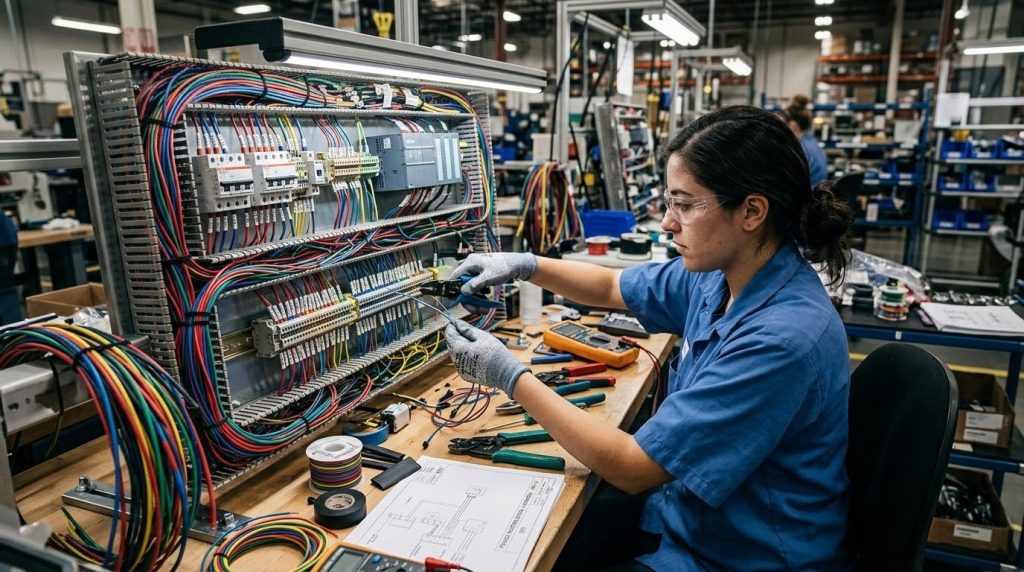
Robots rarely work in pristine environments. Most industrial systems operate in welding bays, heavy machining centers, or food processing plants. The environment dictates the choice of outer jacket material. Polyvinyl chloride works fine for static applications in clean areas, but it stiffens and cracks when exposed to cold temperatures or synthetic industrial oils.
If you deal with aggressive cutting fluids, polyurethane is usually the better choice. It offers excellent abrasion resistance and handles continuous flexing very well. For extreme temperature variations or exposure to weld slag, you might have to look at silicone or specially formulated polymers.
Sometimes standard catalog options just don’t cut it for specific industrial requirements. When you need an exact combination of chemical resistance, electrical shielding, and flexibility, sourcing a Custom Cable and Wire Assembly becomes the only viable route. Getting the jacket material right at the design phase stops degradation before it even starts.
Defeating Electromagnetic Interference
Industrial robots use heavy power lines right next to sensitive data communication cables. High voltage servo drives and heavy motors generate massive amounts of electrical noise. If you don’t shield your signal lines properly, you will experience phantom errors, dropped encoder counts, and random machine faults that take days to troubleshoot.
Shielding in a robotic cable is notoriously tricky because standard foil shields crack under continuous flexing. You typically have to use tinned copper braided shields. The coverage angle of the braid needs to be optimized for the specific type of movement. A tight braid offers better electrical protection but severely reduces flexibility.
Some designs utilize a spiral wrap shield, which flexes easily but can open up and create gaps during torsional twisting. You have to balance the need for flexibility with the need for signal integrity. Keep power and data lines as far apart as possible within the physical routing system, relying on both spatial separation and robust physical shielding.
Securing the Terminations
A well designed cable means absolutely nothing if the connectors fail under load. The termination points take the brunt of the mechanical strain. Connectors on a working robot vibrate constantly. You need secure locking mechanisms that won’t back out over a long production run.
Threaded metal connectors with heavy duty strain reliefs are standard in most industrial robotics for a reason. The strain relief ensures the pulling force is applied strictly to the durable cable jacket and not the fragile internal copper conductors. Overmolded connectors offer another layer of protection. By injecting plastic directly over the termination point, you completely seal out moisture and dust while adding rigid mechanical support. It stops operators from accidentally pulling the wires out of the pins when disconnecting a line.
Maintenance also plays a huge role here. When a cable eventually wears out, the maintenance crew needs to swap it fast. Using plug and play circular connectors minimizes downtime. Expecting a technician to wire terminals by hand on a dark factory floor at two in the morning is a recipe for wiring mistakes and extended plant outages.
Getting the Production Right
Designing the cable on paper is only half the job. Building it requires specialized extrusion equipment and deep material expertise. Most standard wire houses simply don’t have the capability to extrude custom jackets or apply the specific low friction internal tapes required for high flex applications.
Working closely with a dedicated robotics cable assembly manufacturer ensures the final product actually matches your engineering requirements. They have the physical testing rigs required to simulate millions of flex and torsion cycles before you ever put the cable into live production.
Testing is non negotiable. A reliable facility won’t just run a quick continuity check and ship the spool. They will put the prototype on a mechanical rig that mimics your exact application. They will twist it, bend it, and pull it until it breaks, measuring the electrical resistance the entire time. You need to know exactly how many millions of cycles the cable will survive so you can establish a realistic preventative maintenance schedule.
Don’t treat cabling as an afterthought. Spend the time upfront to engineer the wiring with the exact same rigor you apply to the mechanical components. It saves a massive amount of headaches and unplanned downtime down the road.