

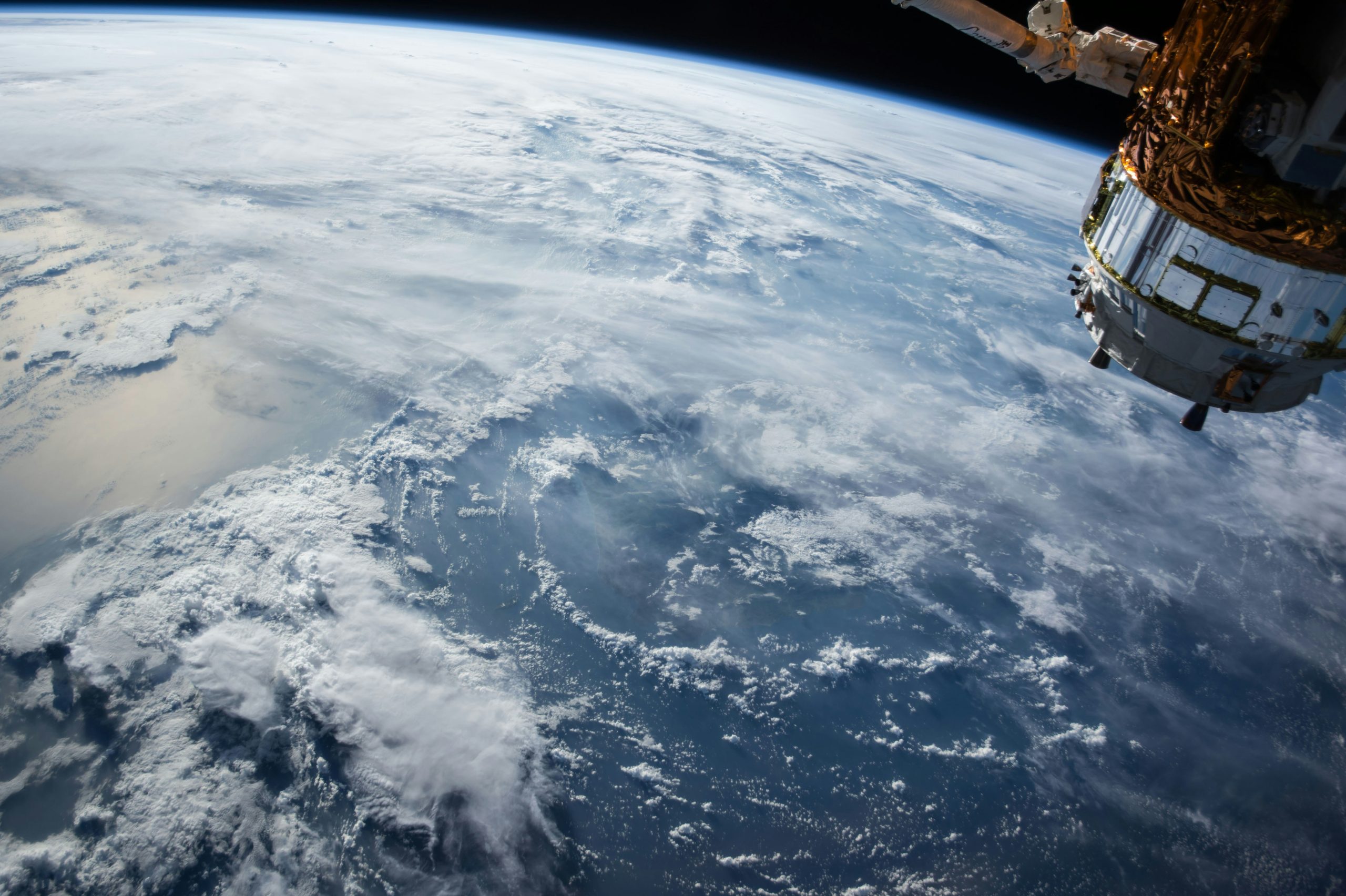
In late March 2026, a Starlink satellite with a code of 34343 lost contact at an altitude of 560 kilometers. SpaceX confirmed an “on-orbit anomaly.” Data from orbital tracking firm LeoLabs showed the satellite had broken up into pieces and scattered debris across the planet’s surface. This was the second such incident in four months. In December 2025, STARLINK-34343 also broke apart due to a malfunction in its internal energy source.
Less than 24 hours after the incident, SpaceX was conducting normal operations, launching 29 new Starlink satellites. This is the most accurate picture of the Starlink project at the moment, with a rapid expansion of the satellite constellation and a rising tide of questions about its long-term viability.
A “Space Empire” of Tens of Thousands of Satellites
As of September 2026, the number of active Starlink satellites in orbit has approached ten thousand, accounting for more than sixty percent of all operational satellites globally. This figure is still growing rapidly: in January 2026, the U.S. Federal Communications Commission (FCC) approved an additional 7,500 second-generation Starlink satellites, bringing the total authorized to 15,000. SpaceX’s ambitions extend far beyond this-the company has already applied to the FCC to launch another 15,000 satellites dedicated to mobile communications and has filed for as many as 100,000 third-generation satellites.
Supporting this growth is the technological upgrade of the Starlink satellites. Each Starlink satelite is equipped with three lasers in space that can communicate between the sats at 200 Gbps, creating a network of space-based Internet without ground stations. The satellites use argon-fueled ion thrusters to deorbit when their lives are over. With these technologies, Starlink can achieve latency of 25 milliseconds at low altitude (550 kilometers), far exceeding the 600 millisec or more experienced by traditional geostationary sattelites.
But “more” is itself the root of the problem.
The Ambition and Cost of Direct-to-Cell
Starlink’s most inventive business development has been its Direct-to-Cell technology, which allows smartphone users to connect directly to satellites without any antenna or other equipment. In September 2026, Kazakhstan was the first country in Central Asia to launch the service, with users of Beeline Kazakhstan able to send texts and access the Internet in areas with no ground signal.
This technology is a bit “clever.” SpaceX didn’t wait for 3GPP NTN to be ready before using existing LTE base station payloads that are designed for use on the ground. Instead, SpaceX has added satellite-based LTE payload technology to its satellites with some special modifications. SpaceX’s approximately 400 direct-to-cell satellites in space utilize T-Mobile’s PCS spectrum and later EchoStar’s AWS-4 spectrum to increase capacity.
In the real world, it is not as smooth as one might think. A recent two-month study by a research team in Tokyo revealed that the Starlink direct-to-cell service has some serious flaws at the physical layer. The physical-layer performance suffers from significant channel quality degradation due to residual frequency error, and the omission of HARQ techniques to handle satellite delay results in all retransmission burdens falling to the RLC layer, which reduces efficiency. The authors’ conclusion was blunt: “it will not be enough to simply add more satellites or allocate more spectrum to alleviate the bottleneck of direct-cell services.”
The Invisible Cost: A “Metal Experiment” in the Atmosphere
When a Starlink satellite reaches the end of its five-year life, it is burned up as it reenters the atmosphere. The “sky burial” has been seen as a clean way to dispose of the satellites. It’s better than becoming space junk. But with thousands of satellites being retired every year, scientists have begun to wonder where these metals go?
In 2023, a group led by NOAA atmospheric chemist Daniel Murphy using aircraft with laser mass spectrometers found twenty metals from spacecraft in the stratosphere at an altitude of 19 kilometers. Lithium, aluminum, copper, and lead were all found in greater concentrations than the natural levels from meteors. Aluminum is the most alarming, because when aluminum oxide gets into the stratopshere, it can react with chlorofluorocarbons and turn into active chlorine, which can destroy the ozone layer.
Scale is intensifying the problem. A 2021 study revealed that if there were 75,000 low-Earth orbit satellites, the amount of human-made materials ejected into the atmosphere would be 40 percent of meteorite input and stratospheric aerosols could double. In February 2026 alone, an average of four Starlink satellites would re-enter the atmosphere each day. An article by the World Economic Forum in March 2026 warned that the launch and reentry of satellites are “significantly altering the chemical composition of the Earth’s middle and upper atmosphere” and that it is threatening to restore the ozone layer and maintain climate stability.
Astronomers’ “Chemotherapy Regimen”
For astronomers on the ground, however, Starlink poses an even greater threat. The Vera Rubin Observatory’s upcoming ten-year survey is expected to capture approximately 1,000 images per night and cover a space 45 times larger than the full moon. Simulations have shown that if there were 40,000 low-Earth-orbiting satellites, at least 10 percent of the images taken by the Vera rubin Observatory (which will be predominantly at twilight) would be covered in satellite trails.
The cost of dealing with these trails is substantial. An astronomer who studies objects beyond the solar system describes the current methods for removing trails as “like chemotherapy drugs: violent, and they erase more than we want to erase.” And it’s even worse because this effort takes up time that should be used for scientific analysis. Some of the smartest people on the team spend hours filtering out satellites rather than studying data.
SpaceX is certainly working to reduce the brightness of satellites. And so far, the new satellites that have been launched have been less reflective. However, as astronomer Samantha Lawler notes, the size of satellite is also increasing, making the brightness issue no better. Direct-to-cell satellites, due to their bigger antennas, are significantly more luminous than regular Starlink satellites due to the enhanced antenna sizes. According to Lawler, “the light reflected from these new satellite antennas will be bright enough to see with the naked eye in a heavily light-polluted city like Toronto.”
The “Deorbit Gamble” of Sustainability
According to SpaceX, a major change in the orbit of many of its satellites was made in 2026, where they lowered the orbits of about 4,400 satellites from 550 kilometers to 480 kilometers. The reason for this is that lower orbits means more drag in the atmosphere, so any debris or failed satellites would be destroyed within weeks rather than remain in orbit for years.
But that’s only a short-term solution. Deorbiting would address the question of “how long debris remains,” but not the question “why satellites fragment.” Two SpaceX satellites disintegrated in four months, and SpaceX has repeatedly used the word “anomaly” to describe the issue. SpaceX never disclosed the exact cause of the failure. Astrophysicist Peter Plavchan from George Mason University has an alarming point: If the satellite fragmentation issues are due to a design flaw, “then it could affect hundreds of Starlink satellites, and the risk would rise substantially.”
In 2025, the Starlink constellation performed almost 300,000 collision avoidance maneuvers. The number itself says a lot. When a single company controls two-thirds of all active satellites, what does it mean to be sustainable?
Starlink’s future lacks neither funding, nor technology, nor launch capacity. What it lacks is an answer: while sending ten thousand, thirty thousand, or even one hundred thousand satellites into the sky, how do we keep low Earth orbit from becoming another environment that needs “chemotherapy”? To this question, SpaceX has yet to offer a convincing response.
GEORGINA WALTON