

Let’s start with what actually happened. On February 26, negotiations in Geneva between the US and Iran collapsed. Not gradually. Not with a whimper. They imploded .
Here’s the context you need: Iran has been rocked by massive protests since December, triggered by economic collapse and met with a brutal crackdown that human rights groups estimate killed over 7,000 people . Trump had been watching this unfold, making bold promises to the Iranian people that “help is on its way” . At the same time, negotiations over Iran’s nuclear program were going nowhere. The US was demanding Iran completely abandon enrichment and dismantle its missile program. Iran, which sees its missiles as the only thing keeping foreign powers from doing exactly what’s happening now, refused .
Trump sent his son-in-law Jared Kushner and special envoy Steve Witkoff to Geneva. Iran sent its foreign minister and a full technical team. The Iranians wanted to haggle over details—how much uranium gets shipped out, which sanctions get lifted. Trump’s team wanted a grand symbolic victory: total capitulation on the big stuff . When Iran’s proposal landed and it wasn’t the sweeping surrender Washington wanted, the US walked .
Within 48 hours, Israeli jets were in the air, and Trump was on Truth Social announcing “Operation Epic Fury” .
What Does the United States Really Want? (It’s Complicated)
Here’s where things get interesting. Ask five different experts why the US is doing this, and you’ll get six different answers. Because the truth is, the administration’s objectives are a bit of a mixed bag .
Officially, the stated goals are clear enough :
- Destroy Iran’s nuclear program (again—they claim to have “obliterated” it last June)
- Raze Iran’s ballistic missile industry to the ground
- Annihilate Iran’s navy
- End Iran’s ability to fund and arm proxy groups across the region
Trump laid this out in a Monday morning address, adding that the US is “substantially ahead of our time projections” and that four to five weeks is the expected timeline, though “we have the capability to go far longer” .
But here’s the unspoken stuff that really drives the decision-making:
First, there’s domestic politics. It’s 2026. Midterm elections are looming. For Trump, taking a hard line on Iran is an easy way to bolster the administration’s foreign policy credibility and distract from whatever else is happening at home . For Israeli Prime Minister Benjamin Netanyahu, who faces his own elections, demonstrating resolve against Iran’s nuclear program is political gold—especially when corruption allegations keep circling .
Second, there’s the “I told you so” factor. Trump has spent years trashing the Obama-era nuclear deal. He pulled out of it in 2018. Now he wants to prove that his way—maximum pressure, zero concessions—is the only way that works . The fact that negotiations failed gives him the perfect pretext to say, “See? You can’t deal with these people.”
Third, and this is the one analysts keep circling back to: Trump genuinely seems to want regime change . Not just a weakened Iran. Not just a new nuclear deal. The whole thing. In his speech announcing the strikes, he addressed the Iranian people directly: “When we are finished, take over your government. It will be yours to take. This will be probably your only chance for generations” .
That’s not the language of a limited military campaign. That’s the language of someone hoping the whole house of cards collapses.
But Can Air Power Actually Topple a Regime?
Here’s the billion-dollar question that historians and military analysts keep asking .
Iran is not Venezuela, where the US recently pulled off a dramatic operation to oust Nicolás Maduro . Iran is a country of 90 million people, with a deeply entrenched security apparatus, a revolutionary guard that permeates every aspect of society, and a leadership that has survived 45 years of sanctions, assassinations, and outright war .
Marcus Schneider, an expert at the Friedrich-Ebert-Stiftung in Lebanon, put it bluntly: “That Trump intends to do it only with air power and then believes that the Iranian population will rise amid a war and act against this brutal regime, I find that rather fantastical to imagine” .
The regime’s calculus isn’t that it can match US firepower. It knows it can’t. Its calculus is that it can endure, that it can land enough blows to make the cost unacceptable, and that it can wait out yet another foreign intervention .
How This Could Get Messy (And It’s Already Pretty Messy)
Here’s where we need to talk about scenarios, because the next few weeks could go in a lot of different directions .
The Retaliation Spiral
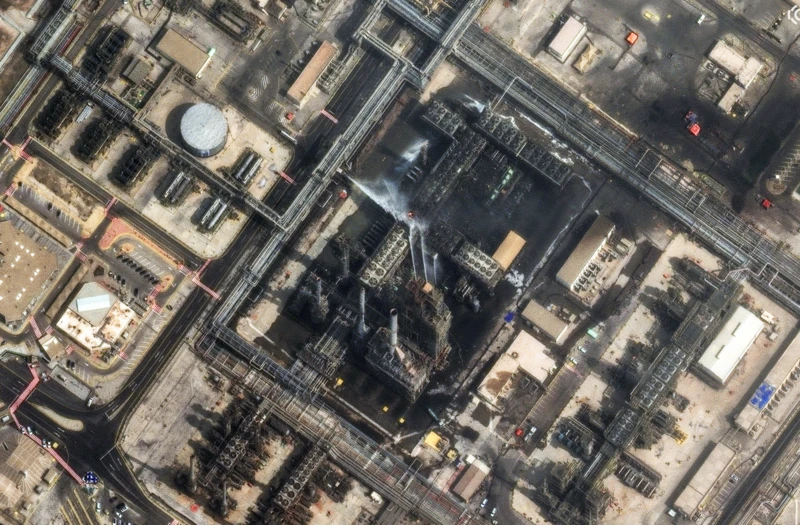
Iran has already launched missiles at US bases in Bahrain, Kuwait, Qatar, and the UAE . The headquarters of the US Navy’s Fifth Fleet in Bahrain was reportedly hit . Explosions have been reported in Abu Dhabi . This is not a one-and-done response. Iran’s Revolutionary Guard has warned that “all US assets throughout the region are considered legitimate targets” and that the operation “will continue relentlessly until the enemy is decisively defeated” .
Iran also has proxies—Hezbollah in Lebanon, militias in Iraq, the Houthis in Yemen—that can open multiple fronts simultaneously . If that happens, Israel could face attacks from the north and south, and US forces scattered across the region become targets.
The Maritime Wildcard
Iran has long threatened to close the Strait of Hormuz, through which about a fifth of the world’s oil passes . They’ve never actually done it, but they’ve never been backed into quite this corner before . If they start seizing tankers or targeting Gulf energy infrastructure, oil prices spike, global markets panic, and suddenly this isn’t just a Middle East problem—it’s everyone’s problem .
The Protest Question
Trump is clearly hoping that Iranians will rise up and finish the job . And yes, there have been massive protests. Yes, the regime is unpopular. But here’s the complication: foreign intervention has a funny way of triggering nationalist backlash. Even Iranians who hate their government may rally around the flag when American bombs are falling .
If protests do erupt and the regime cracks down even harder—which it will—the death toll could climb far beyond what we’ve already seen.
The Regime Survival Scenario
Here’s the outcome that analysts keep circling back to as the most likely, even if it’s also the most frustrating . The Islamic Republic has survived 45 years of pressure. Its security apparatus is designed for continuity. Even if Supreme Leader Ayatollah Ali Khamenei were killed—and at 86, that’s not impossible—the system is structured to keep functioning . Power is dispersed across clerical bodies and military institutions that have prepared for exactly this kind of disruption .
If that happens, we’re left with a weakened but even more hardened Iran, one that will spend the next decade rebuilding its capabilities and nursing an even deeper grudge.
The Dangerous X-Factor: Munitions and Staying Power
Here’s a detail that doesn’t get enough attention in the headlines: both the US and Israel burned through an unprecedented number of interceptors during last June’s 12-day war with Iran . Those stockpiles haven’t been fully replenished .
The Pentagon is now weighing the likelihood that Iran’s retaliation will strain the supply of critical defensive munitions, affecting not just this conflict but also Washington’s ability to respond to other threats around the world . The US can only procure about 12 SM-3 interceptors this fiscal year—at a cost of $445 million—and that’s just not enough for a prolonged campaign .
Stacie Pettyjohn from the Center for a New American Security put it plainly: both defensive and offensive “munitions would be a critical factor that the Pentagon would be highlighting as one of the potential costs of a conflict with Iran, especially if the president were thinking about a more sustained air campaign, and not just some limited punitive strikes” .
The Bottom Line: A Gamble with No Clean Exit
So what does the United States really want from this war?
It wants Iran to stop being a problem. It wants the nuclear program gone, the missiles destroyed, the proxies disarmed, and preferably, the whole regime replaced with something more cooperative . It wants a historic foreign policy win that Trump can run on and that Netanyahu can use to cement his legacy .
But wanting something and getting it are two very different things in the Middle East.
The bloody history of US interventions in this region—Iraq, Afghanistan, Libya—shows that those who launch military assaults are rarely able to control the outcome . Iran is vast, complicated, and deeply resilient. Its leadership is prepared for a fight and has spent months positioning missiles and reinforcing key facilities .
What comes next depends on factors no one can predict: whether protests catch fire, whether proxies escalate, whether miscalculations turn a limited campaign into a prolonged war, whether the regime cracks or hardens, whether American voters have the stomach for another Middle East conflict when the body bags start coming home .
Four American service members have already been killed . More will follow.
Trump insists he won’t get bored. “There’s nothing boring about this,” he said . He’s right about that. The question is whether “not boring” turns into “unwinnable,” and how many people have to pay the price before anyone in Washington is willing to ask that question out loud.
by M. RADCLIFF