

Your phone is full of photos you’ll never look at again. Your laptop has 47 versions of the same document. Your external hard drive is beeping ominously, reminding you that it’s only a matter of time before it dies and takes your digital life with it.
Now imagine this: instead of fragile spinning disks or finicky solid-state drives that degrade faster than a carton of milk left in the sun, your data lives on a piece of glass. Not fancy glass. Not lab-grown, sci-fi glass. The same glass your grandmother used to bake lasagna.
Welcome to Microsoft’s Project Silica, the most exciting thing to happen to data storage since someone figured out you could magnetize rust and call it a floppy disk.
The Problem: We’re Drowning in Data and Everything Dies
Here’s the thing about modern storage that nobody tells you. Your hard drive is lying to you. That little spinning disk or that sleek SSD? They’re on borrowed time . Most traditional storage media—hard drives, magnetic tapes, even those fancy solid-state drives—have a life expectancy of about five to ten years . After that, they start degrading. Bits flip. Data corrupts. And suddenly, those baby photos you swore you’d back up are gone forever.
This is what tech people call “data rot,” and it’s the silent killer of digital memories . To fight it, engineers have to constantly copy data from dying drives onto new ones. It’s like playing the world’s most boring game of musical chairs, except the chairs are on fire and cost millions of dollars.
Microsoft’s researchers looked at this problem and asked a very simple question: what if we just… stopped? What if we found something that doesn’t rot, doesn’t degrade, and doesn’t need to be constantly migrated? Something that could sit on a shelf for centuries and still be perfectly readable when our great-great-great-grandchildren finally decide to look at our vacation photos from 2026?
The Science: Tiny Lasers, Big Ideas
Before you start shoving your old wine bottles into your computer, let’s talk about how this actually works. Because it’s not like you can just pour your data onto a window pane and call it a day.
Microsoft’s researchers use something called a femtosecond laser . If that sounds impressive, it’s because it is. “Femtosecond” means a quadrillionth of a second. That’s so fast that trying to wrap your head around it will probably make your brain hurt. These lasers fire pulses so brief that they can modify the inside of a piece of glass without damaging the surface . It’s like performing surgery on a microscopic level, except the patient is a slab of Pyrex.
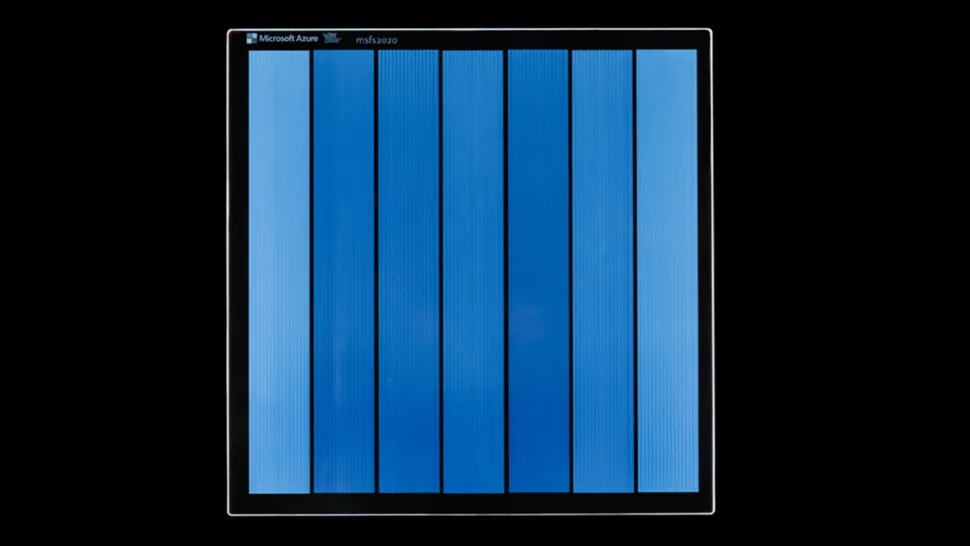
These pulses create tiny 3D structures inside the glass called voxels—think of them as 3D pixels . By stacking hundreds of layers of these voxels in a piece of glass just 2 millimeters thick, the team can pack an astonishing amount of data into a space smaller than your hand .
How much data, you ask? Try 5 terabytes on a single piece of glass the size of a drink coaster . That’s roughly 2 million printed books, or 3,500 high-definition movies, or approximately every embarrassing photo you’ve ever taken, times a hundred .
The Breakthrough: Your Oven Can Help
Here’s where the story gets really interesting. Until very recently, this technology required high-purity fused silica glass—the kind of expensive, hard-to-manufacture material that makes accountants cry and supply chain managers reach for the nearest bottle of something strong .
But in a paper published in Nature (yes, the actual Nature, not “Nature’s Own” discount brand), Microsoft’s team announced they’ve cracked the code on using borosilicate glass . That’s the same stuff your Pyrex measuring cup is made of. The same material as your oven door. The glass that’s been sitting in kitchens for decades, quietly enduring thermal shock while you roast chickens.
This matters more than you might think. By moving to a common, inexpensive material, Microsoft has cleared the biggest hurdle to making this technology practical . Instead of requiring exotic manufacturing processes, these data-storage glass slabs could theoretically be produced using techniques similar to those that make your drinking glasses .
Richard Black, the research director for Project Silica at Microsoft Research, told Nature: “The nice thing about the glass is, once it’s written, it’s immutable. You’re done” . No migrating. No refreshing. No constant, expensive maintenance. Just data, sitting there, waiting patiently for someone to ask for it.
The Reading Room: How to Get Your Data Back
Okay, so you’ve got your data safely stored inside a piece of glass. Now what? How do you actually read it?
The retrieval process is almost as cool as the writing. An automated microscope scans the glass while a machine learning algorithm decodes the captured images to reconstruct the original files . The system uses a convolutional neural network—fancy AI speak for “a computer brain that’s really good at recognizing patterns”—to interpret the voxels and turn them back into the data you stored .
And here’s the really clever part: the new system needs only one camera to read the data, where older versions required three or four . That means cheaper hardware, smaller footprint, and fewer things that can break. It’s like upgrading from a clunky old desktop to a sleek laptop, except the laptop is reading information etched into glass by lasers.
Microsoft has even envisioned entire data centers where racks of these glass plates sit passively, consuming zero energy, until a robotic arm retrieves a specific piece when needed . It’s like a library, but the books are coasters and the librarian is a robot.
The Test: Superman, Music, and the Arctic
You might be thinking, “Sure, this sounds great in theory, but has anyone actually done it?”
Yes. And they’ve done it in style.
Back in 2019, Microsoft teamed up with Warner Bros. to store the entire 1978 Superman movie—you know, the one with Christopher Reeve—on a piece of quartz glass . They picked that film because it’s a landmark in cinema history, and what better way to test your archival technology than by preserving a piece of cultural heritage?
More recently, Microsoft has partnered with the Global Music Vault, a project designed to preserve music recordings for future generations . Where are they keeping this musical time capsule? Deep under the ice in Norway’s Svalbard region . Because nothing says “data security” like burying your hard drive in the Arctic.
There’s even a “Golden Record 2.0” project in the works, crowdsourcing images, sounds, and languages to represent humanity’s diversity, with plans to launch it into deep space . It’s like the Voyager Golden Record, but with better storage technology and probably fewer complaints about alien copyright infringement.
The Catch: You’re Not Getting One for Your Desk
Before you start planning to replace your laptop’s SSD with a slice of Pyrex, let’s manage expectations. Project Silica is not coming to a Best Buy near you anytime soon .
The write speed is currently around 3.13 MB/s for phase voxels, which is… let’s call it “leisurely” . By comparison, a typical SSD can write at 7,000 MB/s. At that rate, filling a 5TB glass plate would take about 150 hours . That’s six days of continuous writing. For one coaster.
The technology is aimed at archival storage—the kind of data that needs to be kept forever but doesn’t need to be accessed every day . Think medical records, historical archives, scientific data, film masters, financial transaction histories . Things that, if lost, would represent an irreplaceable loss to history or civilization.
Microsoft estimates it will take another three to four development stages before the technology is commercially viable . So don’t hold your breath, but maybe start clearing a shelf for when it eventually arrives.
The Long Game: 10,000 Years of Data
Here’s the stat that makes your current backup strategy look adorable: Microsoft’s accelerated aging tests suggest data stored in borosilicate glass could remain intact for over 10,000 years at room temperature .
Ten. Thousand. Years.
To put that in perspective, 10,000 years ago, humans were just figuring out agriculture. The wheel hadn’t been invented. The pyramids wouldn’t be built for another 7,500 years. This piece of glass could outlast civilizations, languages, maybe even the human species itself.
The team achieved this by heating written glass to over 400°C, observing how the voxels degraded, and extrapolating to room temperature . It’s like watching your data age in fast-forward, then calculating that at normal speed, it’ll be fine until our descendants have evolved into whatever comes next.
And because glass is resistant to water, heat, dust, and electromagnetic interference, it doesn’t need the climate-controlled, energy-hungry environments that traditional data centers require . You could literally leave it in a cave for millennia and still read it when you came back.
The Bottom Line: Data That Outlasts Us
So what does this all mean for you, the person who just wants to make sure their wedding photos don’t disappear into the digital ether?
In the short term, not much. You’ll keep backing up to hard drives and cloud services for the foreseeable future. But in the long term, Microsoft’s Project Silica represents something genuinely profound: the first storage medium that might actually outlast its creators .
Think about what that means for history. For science. For culture. Future archaeologists won’t have to piece together fragments of pottery to understand our civilization. They’ll just grab a coaster, pop it under a microscope, and watch Superman in 4K.
The research phase is complete . The technology works. The materials are common. The only questions left are about scaling, speed, and cost. But for the first time in human history, we have a way to preserve digital information that doesn’t require constant attention, endless energy, or blind faith that someone will remember to copy it before it rots away.
As one researcher put it, “Glass is a permanent data storage material” . Permanent. Not “temporary if you’re careful.” Not “good for a decade or two.” Permanent.
So the next time you pull a Pyrex dish out of your oven, take a moment to appreciate it. That humble piece of kitchen equipment might just be the future of human memory. And if Microsoft has its way, your great-great-great-grandchildren might one day pull a similar piece of glass off a shelf and see exactly what you looked like at that terrible office Christmas party in 2025.
Whether that’s a gift or a curse depends entirely on how many selfies you took.
by ERIKA THORTON