

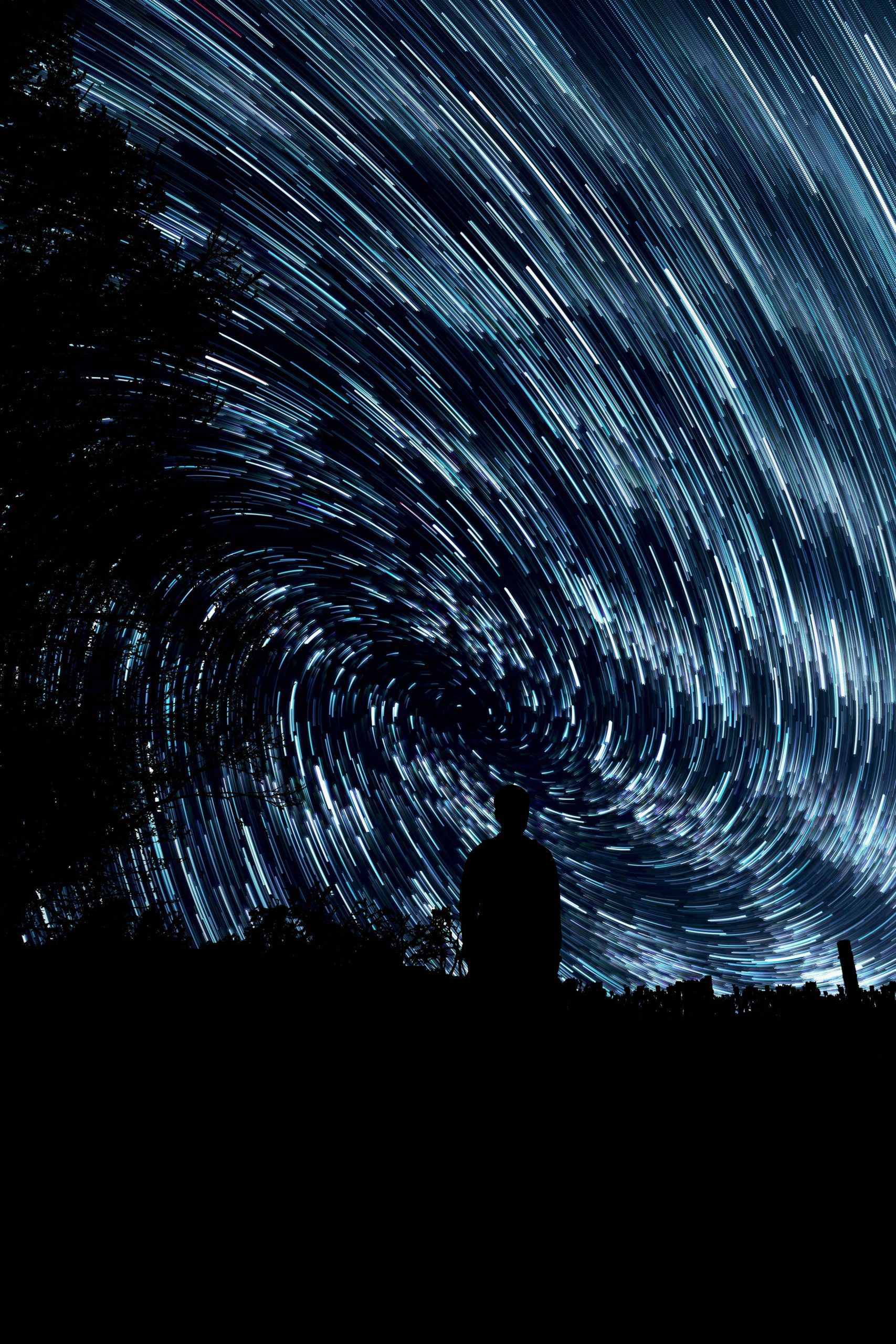
Here’s a thought for your next date or deep, late-night conversation: what if the very fabric of reality isn’t cold, dead, and empty, but is… well, a little bit in love? What if the connections we feel—that inexplicable pull towards another person, the sense of being intertwined—aren’t just beautiful human metaphors, but whispers of a fundamental cosmic rule? This isn’t poetry (though it sounds like it). This is the cutting edge of physics, where scientists are discovering that space, time, and matter might be entangled in a cosmic dance so intimate it makes your favorite romance look like a casual acquaintance.
For centuries, we thought of space as a static stage and time as a relentless river. Then came Einstein, who brilliantly twisted them together into a single fabric: space-time. But the real plot twist is happening now in quantum labs. The latest, weirdest chapter suggests this fabric isn’t just curved by mass, as Einstein showed. It might be stitched together by something far stranger: quantum entanglement.
So, let’s untangle this mind-bender together. Is the universe giving us a grand, scientific love story?
The “Spooky” Love Story of Particles
First, we need to understand the original cosmic romance: quantum entanglement. Imagine two particles, born from the same event. According to the rules of quantum mechanics, they can become “entangled.” This means their fates are linked in such a profound way that measuring a property (like “spin”) of one particle instantly tells you the property of the other, even if it’s on the other side of the galaxy.
Einstein hated this idea. He called it “spooky action at a distance”. To him, it seemed like information was traveling faster than light, breaking the universe’s speed limit. He insisted there must be some hidden, classical explanation. For decades, it was a beautiful theory. But then, scientists started testing it.
In groundbreaking experiments, physicists like Anton Zeilinger sent entangled photons to detectors (lovingly named “Alice” and “Bob”) hundreds of meters apart. When Alice measured her photon, Bob’s photon reacted instantly, confirming their deep connection. They even used starlight 600 light-years old to “decide” what measurements to make, slamming the door on most possible loopholes. The verdict? This “spooky” love is very, very real. These particles aren’t just close; they are parts of a single, inseparable whole.
From Particle Love to the Fabric of Reality
This is where it gets universe-altering. For a long time, we thought entanglement was a cool party trick for tiny particles. But the big question looming over physics is: how does gravity, which shapes the cosmos, fit with quantum mechanics, which rules the tiny world? This quest for “quantum gravity” is physics’ biggest puzzle.
Leading theories, like loop quantum gravity, propose a radical answer: the very threads of space-time might be woven from a network of tiny, entangled loops. Think of space not as smooth and continuous, but as a fabric made of interlinking rings. The connections between these rings—their entanglement—is what creates the experience of contiguous, three-dimensional space and the flow of time.
A philosopher of physics, Elise Crull, puts it beautifully: “Entanglement is a property of space and time”. It’s not just something that happens in space; it might be the foundational property that creates space and the correlations across time.
Recent experiments are hinting at this mind-blowing possibility. Scientists are now probing “temporal entanglement,” where particles that never coexisted in time still show linked properties. It’s as if the universe is keeping a permanent record of connections, written into the fabric of reality itself.
Bending the Rules: The Hidden Geometry Within
The echoes of this cosmic entanglement appear even in the materials of our daily future. In a stunning 2026 discovery, scientists observed a “hidden quantum geometry” inside certain materials that bends the paths of electrons, exactly as gravity bends light in space. This “quantum metric” is a direct measure of the warped, internal landscape electrons move through.
What they found is revolutionary: this geometry isn’t a rare fluke. It’s a fundamental feature of many quantum materials. This means the eerie, connection-based rules of the quantum realm directly dictate how real-world materials conduct electricity and interact with light, paving the way for ultra-fast electronics and quantum technologies. The universe’s “love story” is, quite literally, powering our next tech revolution.
So, Is Space “In Love”?
In the strict, Valentine’s Day sense, no. Space doesn’t have feelings. But if we define “love” as the fundamental force of connection, the inseparable linking of fates, and the creation of something greater from the bonding of individual parts, then the universe is doing something that feels deeply familiar.
The human experience of love—feeling connected to someone regardless of distance, being changed by your relationship, forming a new “whole” with another—is a powerful, macroscopic echo of the universe’s most basic operating principle.
- Inseparability: In love, two people become a “we.” In entanglement, two particles become a single quantum state.
- Instant Connection: Loved ones can often feel each other’s emotions across a room. Entangled particles react instantly across the universe.
- Creating Reality: A strong relationship creates a new shared world for a couple. On a cosmic scale, entanglement might be what creates the very arena of space-time where our world exists.
Physicist Carlo Rovelli, a pioneer of loop quantum gravity, and philosopher Nick Huggett envision experiments to test this. They imagine placing a small object in a quantum superposition (being in two places at once). If gravity is quantum, then that object would create a superposition of two different space-time geometries. The very fabric of reality would be in two shapes at once, “entangled” with the object’s location. Proving this would show that space-time itself is born from quantum connection.
The Human Reflection: Love as a Cosmic Echo
This science gives us a stunning new lens on human connection. When you feel deeply bonded to someone, you are, in a way, manifesting a principle that is woven into the foundation of everything. The “observer effect” in quantum physics—where the act of measurement changes the outcome—finds a parallel in relationships: how we pay attention to our partners shapes the relationship itself. The “uncertainty principle” mirrors the beautiful, unpredictable dance of love, where pinning down one aspect (certainty) can make another (spontaneity) more elusive.
This isn’t reducing love to physics. It’s elevating both. It suggests that the longing for connection, the joy of unity, and the mystery of binding relationships are not accidental biological quirks. They are reflections of the universe’s deepest nature.
The Grand Finale: A Universe Woven from Connection
The story of modern physics is evolving from a tale of lonely particles bouncing in a void to an epic of intimate connection. The emerging picture is of a universe where to be is to be related. Entanglement isn’t a minor curiosity; it appears to be the needle and thread sewing the cosmic quilt.
The 2022 Nobel Prize in Physics was awarded for experiments proving entanglement. The 2026 discovery of the “quantum metric” shows it bending electrons in our labs. The next step is to see if it bends reality itself.
So, the next time you look up at the stars, consider this: the vast space between them might not be empty. It might be thrumming with invisible threads of connection, a cosmic web of relationships that makes existence possible. In striving to understand the universe, we may have discovered its greatest secret: at its heart, it is not a collection of isolated things, but a magnificent, entangled whole.
And in our own small way, when we love and connect, we are not just living our lives. We are resonating with the oldest song of the cosmos.
BY BOB JONES