

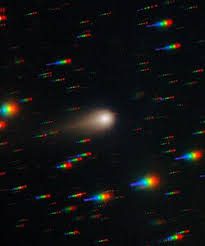
A Rare Interstellar Visitor
In the vast expanse of our solar system, astronomers are tracking an extraordinary celestial object—comet 3I/ATLAS. This rare interstellar visitor, only the third such object ever detected passing through our cosmic neighborhood, is currently captivating scientists worldwide as it journeys through our solar system. Discovered just months ago, this mysterious comet offers a unprecedented opportunity to study material that originated around another star, potentially holding clues about the formation of planetary systems far beyond our own.
As Dr. Michael Kueppers, project scientist for ESA’s upcoming Comet Interceptor mission, notes: “When we started the mission in 2019, we knew only one interstellar object. Since then, two more such objects have been discovered, showing large diversity in their appearance. Visiting one could provide a breakthrough in understanding their nature” .
Discovery and Global Tracking Efforts
Comet 3I/ATLAS was first spotted on July 1, 2025, by the NASA-funded Asteroid Terrestrial-impact Last Alert System (ATLAS) telescope located in Río Hurtado, Chile . At the time of its discovery, the comet was approximately 4.5 astronomical units from the Sun—within Jupiter’s orbit—and traveling at an astonishing 137,000 miles per hour (221,000 kilometers per hour) .
The celestial object was initially given the temporary designation ‘A11pl3Z’ before officially being classified as an interstellar comet and receiving its current name, which follows the naming convention for such objects: “3I” indicates it’s the third interstellar object discovered, while “ATLAS” honors the survey team that found it .
Once identified as interstellar, astronomers around the world mobilized to track this rare visitor. The European Space Agency (ESA) directed ground-based telescopes in Hawaii, Chile, and Australia toward the comet, while space telescopes including NASA’s Hubble and James Webb also turned their instruments to observe it . These early observations confirmed the comet was “clearly active” with a diffuse appearance, indicating it possessed the characteristic coma of a comet rather than appearing as a simple point of light like an asteroid .
*Table: Key Discovery Facts of 3I/ATLAS*
| Feature | Details |
|---|---|
| Discovery Date | July 1, 2025 |
| Discoverer | ATLAS survey telescope, Chile |
| Initial Distance from Sun | 4.5 AU (within Jupiter’s orbit) |
| Initial Speed | 137,000 mph (221,000 km/h) |
| Pre-discovery Observations | Dating back to May 21, 2025 |
| Official Designation | Third interstellar object detected |
A Close Encounter with Mars
Between October 1-7, 2025, comet 3I/ATLAS made its closest approach to Mars, passing approximately 30 million kilometers from the Red Planet on October 3 . This Martian flyby provided a unique opportunity for spacecraft orbiting Mars to study the interstellar visitor up close.
ESA’s ExoMars Trace Gas Orbiter (TGO) and Mars Express spacecraft both successfully observed the comet during this period . The ExoMars TGO captured a series of images showing the comet’s bright, fuzzy coma—the cloud of gas and dust surrounding its nucleus—as it moved against the background stars.
“This was a very challenging observation for the instrument,” said Nick Thomas, Principal Investigator of the CaSSIS camera on ExoMars TGO. “The comet is around 10,000 to 100,000 times fainter than our usual target” . While the spacecraft couldn’t resolve the comet’s nucleus—which would have been as difficult as spotting a mobile phone on the Moon from Earth—the surrounding coma, measuring several thousand kilometers across, was clearly visible .
Scientific Revelations and Composition
Analysis of 3I/ATLAS has already yielded fascinating insights into its composition and behavior. According to observations from the James Webb Space Telescope, the comet is unusually rich in carbon dioxide while containing smaller amounts of water ice, water vapor, carbon monoxide, and carbonyl sulfide . Additionally, the Very Large Telescope has detected cyanide gas and atomic nickel vapor in concentrations similar to those found in comets within our solar system .
The size of the comet’s nucleus remains uncertain because its light blends with the surrounding coma, but Hubble Space Telescope observations suggest a diameter between 440 meters and 5.6 kilometers, with the most likely estimate being less than 1 kilometer . This solid, icy nucleus is surrounded by a coma that spans several thousand kilometers—a product of the Sun’s heat and radiation vaporizing volatile ices as the comet approaches our star .
*Table: Physical Characteristics and Composition of 3I/ATLAS*
| Characteristic | Findings |
|---|---|
| Nucleus Size | Between 440 meters and 5.6 kilometers (most likely <1 km) |
| Coma Diameter | Several thousand kilometers |
| Primary Composition | Unusually rich in carbon dioxide |
| Other Detected Elements | Water ice, water vapor, carbon monoxide, carbonyl sulfide |
| Additional Emissions | Cyanide gas, atomic nickel vapor |
| Activity Cause | Sublimation of ices due to solar heating |
An Ancient Artifact from Deep Space and Future Observations
What makes 3I/ATLAS particularly fascinating to scientists is its potential age and origin. Based on its trajectory, astronomers suspect this comet could be the oldest ever observed—possibly three billion years older than our 4.6-billion-year-old solar system . This ancient traveler may have originated from either the Milky Way’s thin disk or thick disk; if from the latter, it could be at least 7 billion years old .
Comet 3I/ATLAS follows a hyperbolic trajectory, meaning it’s not gravitationally bound to our Sun and will pass through our solar system only once before continuing into interstellar space . The comet is expected to reach its closest point to the Sun (perihelion) around October 30, 2025, at a distance of approximately 1.36 astronomical units—just inside the orbit of Mars . Fortunately, it poses no danger to Earth, as it will come no closer than 1.8 astronomical units (about 270 million kilometers) from our planet .
Following its solar encounter, the comet will become unobservable from Earth until early December 2025, when it reemerges on the other side of the Sun . Future observations are planned with various spacecraft, including ESA’s Jupiter Icy Moons Explorer (Juice), which will observe the comet after its closest solar approach when it’s expected to be more active .
The Significance of Interstellar Visitors
The study of interstellar objects like 3I/ATLAS provides scientists with a unique opportunity to examine material formed in other star systems without leaving our own solar neighborhood. As ESA explains: “These comets are absolutely foreign. Every planet, moon, asteroid, comet and lifeform in our Solar System share a common origin. But interstellar comets are true outsiders, carrying clues about the formation of worlds far beyond our own” .
The detection of 3I/ATLAS marks only the third time such an interstellar object has been observed, following 1I/’Oumuamua in 2017 and 2I/Borisov in 2019 . The increasing frequency of these discoveries suggests such visitors might be more common than previously thought, prompting increased interest in developing missions specifically designed to study them.
To this end, ESA is preparing the Comet Interceptor mission, scheduled to launch in 2029 . This innovative spacecraft will wait in a parking orbit around Earth until a suitable target is identified—potentially a pristine comet from the distant Oort Cloud or, if we’re fortunate, another interstellar object like 3I/ATLAS .
A Continuing Cosmic Journey
As comet 3I/ATLAS continues its journey through our solar system, astronomers worldwide will maintain their vigilant watch, using every available tool to extract the secrets this interstellar messenger carries. Each observation adds another piece to the puzzle of how planetary systems form and evolve around other stars.
While 3I/ATLAS may be just beginning its scientific story for humanity, it represents a profound connection to the cosmos beyond our solar neighborhood—a reminder that we live in a dynamic universe where celestial objects regularly traverse the vast distances between stars, carrying with them the chemical history of their birthplaces.
For now, this ancient traveler continues its solitary journey through our cosmic neighborhood, briefly illuminating the night skies not just with its physical presence, but with the profound insights it offers into the workings of our galaxy.
*Image credit: NASA/ESA/CSA observations of comet 3I/ATLAS*