

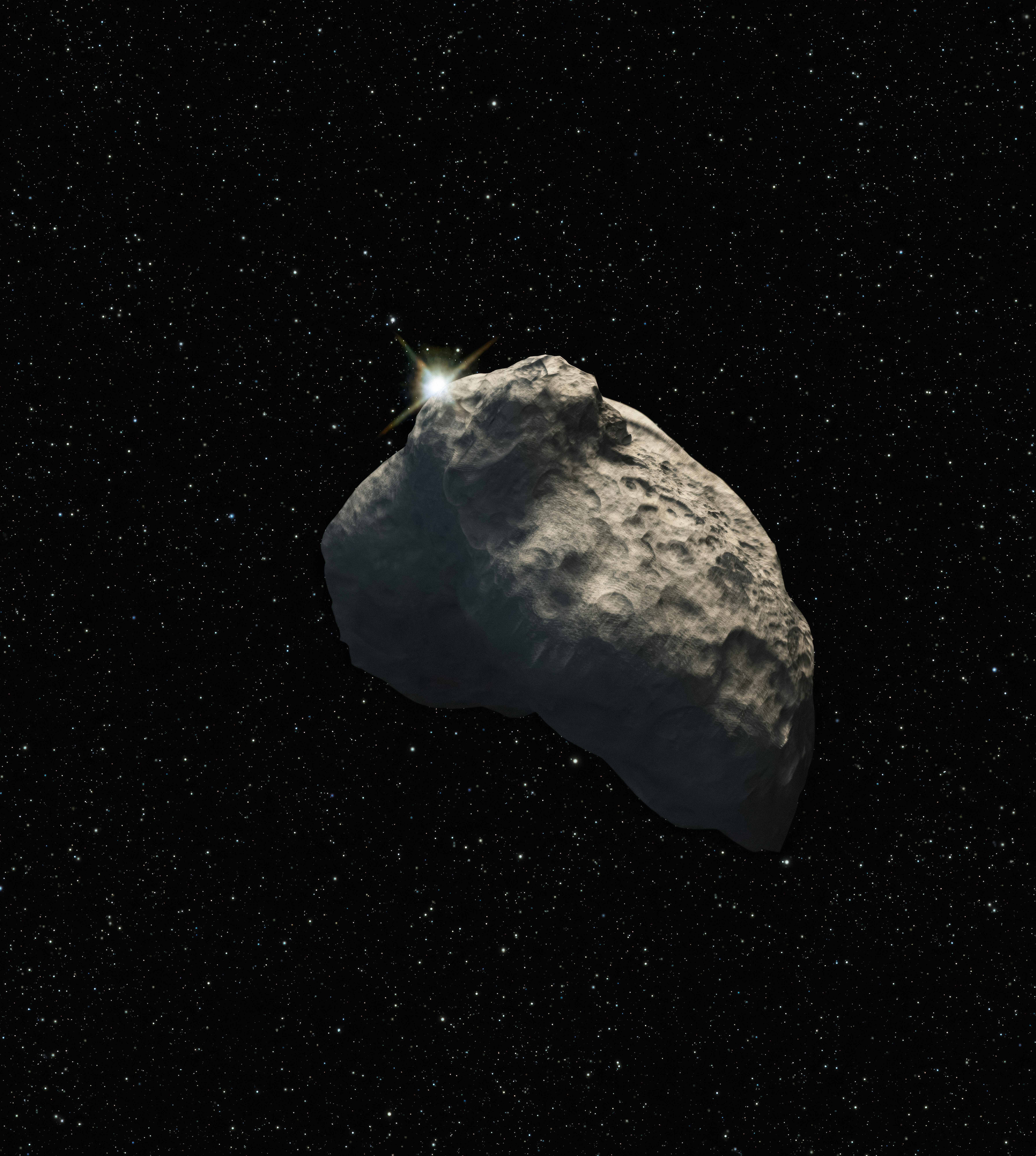
Picture this: On Friday, April 13, 2029, a bright dot will move across the night sky visible to millions without a telescope. That dot is Apophis, an asteroid larger than the Eiffel Tower, passing closer to Earth than many of the satellites in space. A few decades ago, its discovery sparked headlines predicting possible doom. Today, it’s shaping up to be the greatest science lesson in human history.
This is the story of the asteroid Apophis, named after the Egyptian god of chaos and darkness. It’s a tale of initial fear, scientific triumph, and a remarkable opportunity that has united the world’s space agencies in a shared mission of discovery. Let’s unravel the journey of this famous space rock in a simple, human way.
A Discovery That Sent a (Brief) Chill Down Our Spines
Our story begins on June 19, 2004, when astronomers in Arizona spotted a new, fast-moving point of light in the sky. It was cataloged as asteroid 2004 MN4.
When scientists first plotted its initial, rough orbit, they got a shock: the calculations showed a 2.7% chance it could slam into Earth on April 13, 2029. For a brief, tense period, it reached Level 4 on the Torino Scale, the highest rating any asteroid had ever received.
The thought was terrifying. This wasn’t a small space pebble. It was a mountain, roughly 1,150 feet (350 meters) long on its longest side—that’s taller than the Empire State Building and as wide as five football fields. An impact would release energy equivalent to hundreds of nuclear weapons, capable of devastating an entire region.
It was named Apophis, after the ancient Egyptian serpent that battled the sun god Ra each night, seeking to plunge the world into eternal darkness. The name fit the early narrative perfectly.
The “Keyhole” Problem: Earth’s Gravitational Slingshot
Here’s where the science gets both fascinating and a little nerve-wracking. Scientists quickly ruled out a direct 2029 impact. But a new, more subtle danger emerged: the gravitational keyhole.
Think of Earth’s gravity as a powerful force that can give a passing asteroid a slight “nudge.” A gravitational keyhole is a tiny region of space near Earth—incredibly precise, often only a few hundred meters wide. If Apophis were to pass through this exact spot during its 2029 flyby, Earth’s gravity could tweak its orbit in just the wrong way, setting it on a new path to smash directly into our planet on a future return.
The most concerning keyhole pointed to a potential impact on April 13, 2036. For years, the question hung over the astronomical community: Would Apophis thread this cosmic needle?
The Moment of Reassurance: Risk Ruled Out
The answer came through relentless observation. The world’s most powerful radar telescopes, like NASA’s Goldstone antenna, pinged the asteroid with radio waves to measure its distance and speed with incredible precision.
In March 2021, after a particularly close radar observation campaign, scientists had their definitive answer. The uncertainty in Apophis’s orbit, which was once hundreds of kilometers, shrank to just a few kilometers. They could say with absolute certainty: Apophis will miss the keyhole. It will not hit Earth in 2036, 2068, or for at least the next 100 years.
It was a monumental relief. The European Space Agency officially removed Apophis from its “Risk List” in 2021, closing a 17-year chapter of concern. The focus could finally shift from defense to discovery.
The 2029 Flyby: A Once-in-a-Millennium Show
So, what will happen in 2029? Something spectacular.
- It will be incredibly close: On April 13, 2029, Apophis will zip past Earth at a distance of about 20,000 miles (32,000 kilometers). That’s ten times closer than the Moon and actually closer than some of our highest-flying weather and communications satellites.
- You might see it: For people in parts of Europe, Africa, and Asia, Apophis will appear as a bright, fast-moving star in the night sky, visible without any equipment. An event of this scale with a known object is thought to occur only once every few thousand years.
- Earth will change it forever: Our planet’s gravity will give Apophis a massive cosmic makeover. It will stretch and squeeze the asteroid, possibly triggering “asteroid-quakes” and landslides on its surface. This gravitational slingshot will permanently enlarge its orbit around the Sun, reclassifying it into a different family of asteroids.
A Global Science Party: Spacecrafts on a Rendezvous
Instead of ducking for cover, the world’s space agencies are now planning a welcoming party. This flyby is a perfect, free launch to study a large asteroid up close.
- NASA’s OSIRIS-APEX: Originally the OSIRIS-REx mission that brought back a sample from asteroid Bennu, this spacecraft has been redirected. It will arrive at Apophis shortly after the flyby to study how Earth’s gravity changed it, even firing its engines to stir up surface material.
- ESA’s Ramses: The European Space Agency is planning the Rapid Apophis Mission for Space Safety. Its goal is to rendezvous with Apophis before the flyby and travel alongside it, getting a front-row seat to all the changes in real-time.
- The UN’s “International Year”: Recognizing the unique moment, the United Nations has declared 2029 the International Year of Asteroid Awareness and Planetary Defence. This global event will use the Apophis flyby to educate everyone about the risks—and the wonders—of asteroids.
What If the Unthinkable Had Happened?
It’s natural to wonder: what if Apophis had been on a collision course? The scenarios, while no longer a threat, teach us a lot.
Destructive Power: An Apophis-sized impact would be a regional catastrophe, not a planet-ending event. It would excavate a crater miles deep and devastate an area hundreds of miles across.
Planetary Defense is Real: The good news is, with years or decades of warning, scientists believe we could deflect an asteroid like Apophis. Missions like NASA’s DART have already proven we can change an asteroid’s path by smashing a spacecraft into it. The key is finding them early—which is exactly why tracking objects like Apophis is so critical.
The Bottom Line: From Fear to Fascination
The story of Apophis is a powerful metaphor for our place in the cosmos. It reminds us that we share our neighborhood with ancient, wandering rocks. Its initial discovery tapped into a primal fear. But through the steady, international work of science, that fear has been transformed.
Apophis is no longer a bringer of chaos. It has become a messenger. Its close approach in 2029 is not a threat, but a gift—a chance to look a primordial piece of our solar system in the eye, to test our planetary defense coordination, and to inspire a global audience with the reality and beauty of our cosmic environment.
So, mark your calendar for April 13, 2029. Look up. And remember that the bright dot gliding silently past is a symbol of human curiosity triumphing over fear. It’s proof that by understanding the universe, we can move from dread to wonder.
by ZACH BENSON