

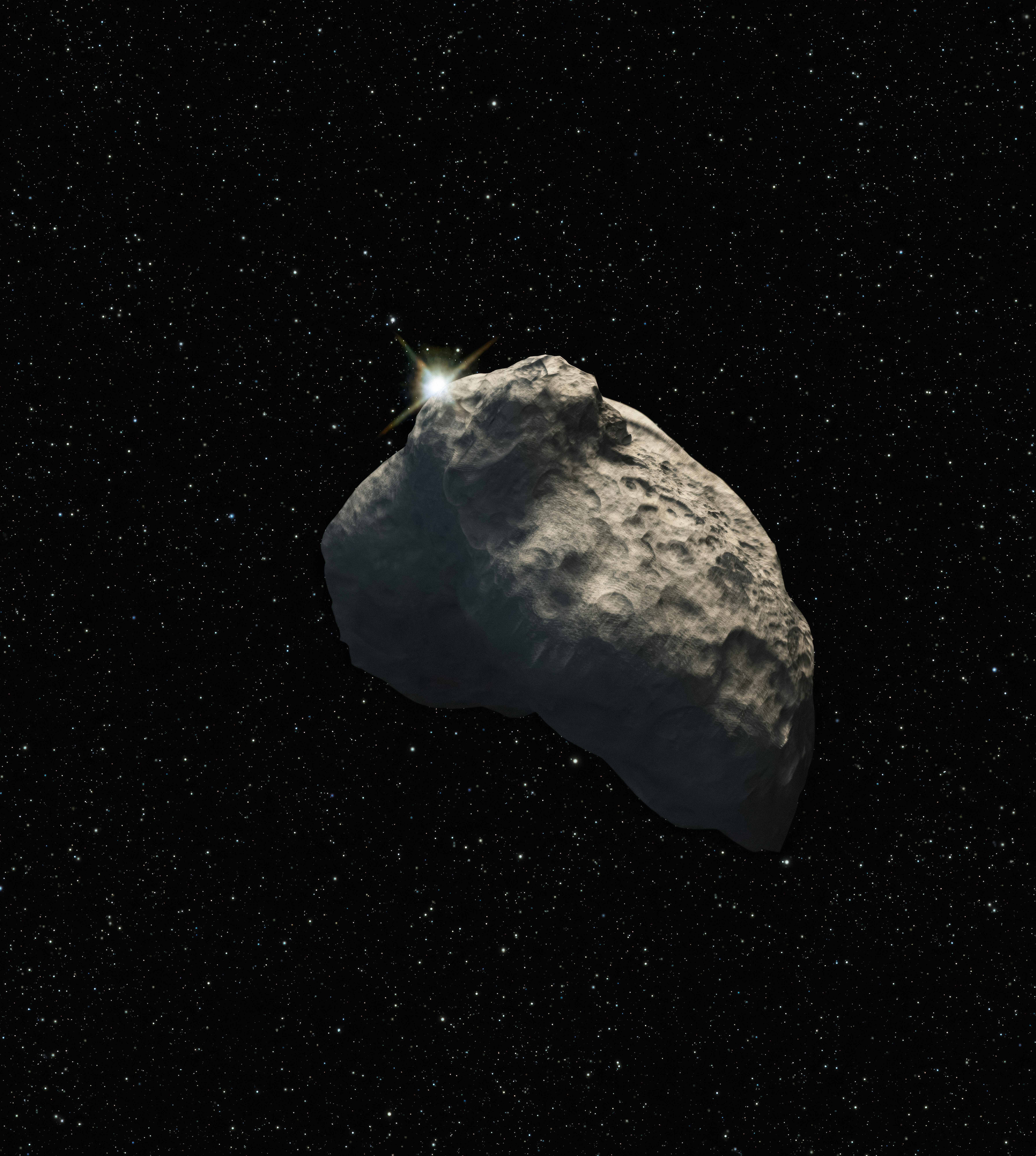
On Friday, April 13, 2029, an asteroid named after the ancient Egyptian god of destruction will make a historic and entirely safe visit to Earth’s neighborhood. Known formally as 99942 Apophis, this skyscraper-sized space rock will pass even closer to our planet than many of our own satellites, giving scientists a rare opportunity and providing a celestial spectacle for billions.
A Close Shave with History
When Apophis was discovered in 2004, it caused concern throughout the astronomical community. Early calculations pointed to a 1-in-37 chance of an impact with Earth in 2029, making it the most hazardous asteroid known at that time. The potential energy from such an impact, involving a 340-meter-wide object, would have been catastrophic.
Thankfully, those worries have now been put to rest. After more than two decades of careful observations, NASA and other space agencies have confirmed that an impact is completely ruled out for 2029 and for at least the next century. As one scientist said, the message is clear: “Apophis will safely pass the Earth.”
What to Expect on April 13, 2029
Instead of a collision, Apophis will put on a remarkable show. At its closest approach, at approximately 5:45 p.m. EDT (21:45 UTC) on April 13, 2029, the asteroid will be just 32,000 kilometers (about 19,700 miles) above Earth’s surface. To put that into perspective, this is even closer than many geostationary communication satellites, which orbit at about 40,000 kilometers away.
This is a truly rare event. A flyby this close by an asteroid of this size is thought to happen only once every 5,000 to 10,000 years.
Remarkably, the event will be visible to the naked eye for a large part of the world’s population. An estimated 7.6 billion people—roughly 90% of the global population—could potentially spot the asteroid as a point of light slowly moving across the sky. It will not look like a shooting star but rather as a steady, slowly moving “star” crossing the sky over several hours. The asteroid is expected to remain visible for about seven hours, starting over Australia and ending over the North Atlantic.
A Fleet of Spacecraft to Greet It
The scientific community is getting ready for Apophis’s visit with a level of coordination not seen before. Several space missions are scheduled to meet the asteroid, turning this historic event into a rich source of data.
- NASA’s OSIRIS-APEX: After successfully delivering a sample from asteroid Bennu, NASA’s OSIRIS-REx spacecraft was given a new mission. Now called OSIRIS-APEX, it will meet Apophis in June 2029 for an 18-month campaign to map its surface and study its chemical makeup.
- ESA’s RAMSES: The European Space Agency’s Rapid Apophis Mission for Space Safety (Ramses) is planned to arrive at Apophis two months before the flyby, in February 2029. It will travel with the asteroid through the encounter, observing in real time how Earth’s gravity affects it.
- Other Missions: Russia has announced plans to develop a mission concept to send CubeSats for a close inspection. A student-led mission from Tsinghua University in China, named START, is also expected to fly by Apophis in April 2029 to capture high-resolution images of its surface.
The Science of a Flyby
The close encounter is not just a visual treat; it’s also a unique scientific experiment. As Apophis passes Earth, our planet’s strong gravity will tug on the asteroid.
This process is expected to set off “asteroid quakes” and landslides on its surface, possibly revealing fresh material beneath its weathered exterior.
By studying these effects, scientists hope to learn more about the asteroid’s internal structure and what it is made of. Apophis is believed to be a “rubble pile“—a collection of boulders and rocks held together by gravity. Understanding how such an object reacts to tidal forces is important for planetary defense, since it helps inform how we might deflect a possible future threat.
The event is also the reason the United Nations declared 2029 as the International Year of Asteroid Awareness and Planetary Defence. The goal is to use the global interest in Apophis to highlight the importance of working together to reduce potential hazards from near-Earth objects.
Looking Forward
In recognition of the event’s significance, the United Nations has declared 2029 as the International Year of Asteroid Awareness and Planetary Defence. This global campaign will use the flyby as a chance to educate the public about asteroids and the importance of collaborative space science.
As 2029 gets closer, Apophis will change from a feared threat into a global teacher and a stunning sight in our skies. It serves as a strong reminder that our solar system is always changing, and that through science and cooperation, we can turn possible danger into a real opportunity for discovery.
JANET EDWARS