

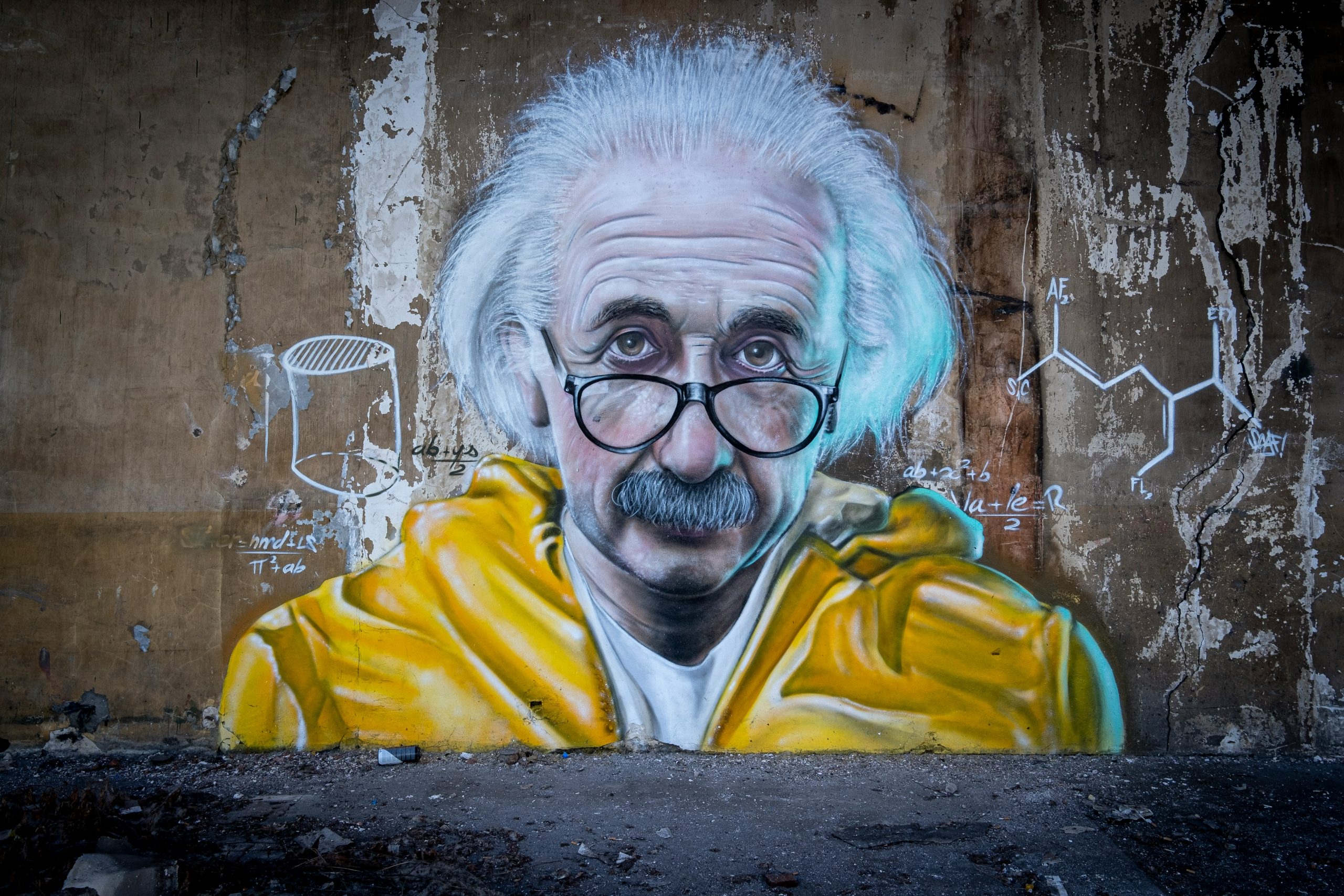
Alright, let’s set the scene. You’re late. You’re sprinting to catch the 8:05 bus, your heart hammering against your ribs like it’s trying to escape and catch its own bus. You make it, collapsing into a seat as the world blurs past. For you, that frantic minute felt like an eternity. For the calm person who’s been on the bus since the terminal, it was a blink.
That, right there, is your personal, sweaty introduction to Einstein’s Theory of Relativity. Now, imagine the man himself, with that iconic wild hair and kind eyes, sitting across from you. You’re mopping your brow, and he says, with a gentle German accent, “My friend, you have just proven my theory. Time did slow down for you. Your heart rate is your personal clock, and it was moving at a very different speed than the clock on the city hall.”
This is the delightful, human truth about Einstein’s universe: it’s not just about spaceships and black holes. Its principles are woven into the fabric of our daily lives, especially our health. If we could ask him about diet, exercise, stress, and aging, his answers wouldn’t be in complex equations, but in profound, witty observations about how we experience our bodies in this relative world.
Lesson 1: The Relativity of a Healthy Minute (Or, Why Treadmill Time is a Lie)
Einstein’s core revelation was that time is not absolute. It stretches and compresses based on your speed and gravity. A clock on a fast-moving spaceship ticks slower than one on Earth.
Now, apply this to your workout. Staring at the clock on the gym wall while you’re on the treadmill? That’s “stationary observer time.” It drags. Each minute feels like an hour. But your personal time—the one measured by your effort, your burning muscles, your focused breath—that’s on a different curve.
Einstein’s Health Hack: “The only way to make exercise time pass quickly,” he might muse, “is to move through it with great joy or great curiosity. Find the speed—the velocity of enjoyment—where your personal clock synchronizes with fun. Then, you are not ‘wasting an hour’; you are investing in the dilation of your vitality.”
In other words, the workout you love (be it dancing, hiking, or swimming) puts you in a flow state where time relatively flies. The one you hate puts you in a time-dilated prison of your own making. The healthiest exercise is, quite literally, the one that makes your personal clock happy.
Lesson 2: E=mc2, The Ultimate Diet Equation (It’s Not What You Think)
This is the most famous equation in history: Energy equals mass times the speed of light squared. We often think of it as about turning mass into explosive energy (like in a nuclear bomb). But Einstein saw it as a statement of equivalence: mass and energy are two forms of the same thing.
For our health, this is a game-changer. Your body is not just a container for food; it is a dynamic energy field. The food you eat (mass) is converted into the energy that powers every thought, heartbeat, and step.
Einstein’s Diet Advice: He’d likely chuckle at fad diets. “You are not ‘gaining mass’ like a inert rock,” he’d say. “You are storing potential energy in a form that does not serve your system’s elegant equations. And c2 is a very large number. A little bit of unhealthy mass represents a vast amount of sluggish, trapped energy.”
The equation teaches quality over mere quantity. You want to put high-quality “mass” (nutritious food) into your system so it can be converted into clean, sustainable energy (E) for living. Processed junk food is like putting dirty coal into a fine engine—it creates energy, but also a lot of wasteful, damaging byproducts (fatigue, inflammation). True health is about optimizing the mass-to-energy conversion in your personal universe.
Lesson 3: The Gravity of Stress and the Curvature of Your World
General Relativity’s masterstroke was reimagining gravity. It’s not a mysterious force pulling at a distance, Einstein said. Instead, mass and energy bend the very fabric of space-time around them. Think of a bowling ball on a trampoline; it creates a warp, and smaller marbles will roll toward it.
Now, think of a major stressor—a looming deadline, a financial worry, a relationship strain. That stressor is your personal bowling ball. It warps your psychological space-time. Everything in your mental universe—your thoughts, your reactions, your sense of time—starts to curve toward that stress. It can feel like you’re in a gravity well, unable to climb out.
Einstein’s Stress Prescription: “You cannot eliminate mass from the universe,” he’d note. “But you can change your relationship to it. Introduce a greater, positive mass—a deep passion, a loving connection, a state of mindfulness. This will create a new curvature, a competing gravity well of well-being that can pull your world into a healthier orbit.”
Meditation, time in nature, a hobby—these aren’t just “relaxing.” They are active interventions that reshape the geometry of your inner universe, counteracting the warping effect of stress-gravity.
A Relativity-Based Health Checklist from the Professor Himself
| Life Situation | Einstein’s Relativistic Perspective | The Practical, Human Takeaway |
|---|---|---|
| The Dreaded Workout | Time dilation is real. Your perception of duration is tied to your frame of reference (joy vs. dread). | Find the “fun frame.” If running is torture, try cycling, dancing, or a sport. Your clock will tick faster. |
| Choosing What to Eat | E=mc2. You are converting mass to energy. The quality of the mass dictates the quality of the energy. | Think “clean fuel.” Ask if the food on your plate will convert to vibrant energy or sluggish, inflammatory residue. |
| Feeling Stressed & Overwhelmed | A large mass (stressor) warps space-time, pulling everything toward it. | Create counter-gravity. Introduce a positive, massive object (a walk, music, a friend) to bend your world back toward balance. |
| Watching Others Age “Better” | All motion is relative. Their biological clock is moving in a different frame—dictated by genetics, habits, and luck. | Focus on your own worldline. Your health journey is your unique path through space-time. Compare less, optimize your own trajectory. |
| Trying to Build a New Habit | Objects in motion (or at rest) tend to stay that way. Changing state requires a force. | Apply a consistent force. Don’t just wish. Use a small, persistent “force” (a 5-minute walk, one less sugary drink) to change your inertia. |
Lesson 4: The Space-Time of Your Life (Or, Your Biological Worldline)
In physics, your path through the four dimensions (three of space, one of time) is called your “worldline.” From birth to the present, you have a unique, unchangeable worldline.
Your health is the story of your biological worldline. Every salad, every cigarette, every night of good sleep, every moment of rage—it’s all a data point on this cosmic chart. The beauty of relativity is that it says your worldline is yours. It is affected by the gravity of your choices and the speed of your living, but it is fundamentally your unique journey.
Einstein’s Final Word on Wellness: He would urge compassion. “Do not look at the sleek worldline of the athlete or the influencer with envy,” he might advise. “You do not know what gravity wells they have navigated. Look only at your own line. See where it has been warped by poor fuel or strong negative gravity. And now, with gentle, consistent force, begin to steer it toward a healthier region of space-time.”
Health, in Einstein’s relativistic view, isn’t about achieving someone else’s absolute ideal. It’s about consciously curving your own personal universe toward more energy, less stressful gravity, and a experience of time filled with things that make your personal clock sing.
So the next time you’re on that hamster wheel, feeling the slow drag of time, remember: you have the power to change your frame of reference. Find your velocity of joy. Choose mass that becomes luminous energy. Place masses of peace to bend your world toward calm. You are not just a body. You are a universe in motion, governed by the same elegant, relative, and wonderfully human rules that govern the stars. Now, go shape your space-time.
by Alexander Schmit